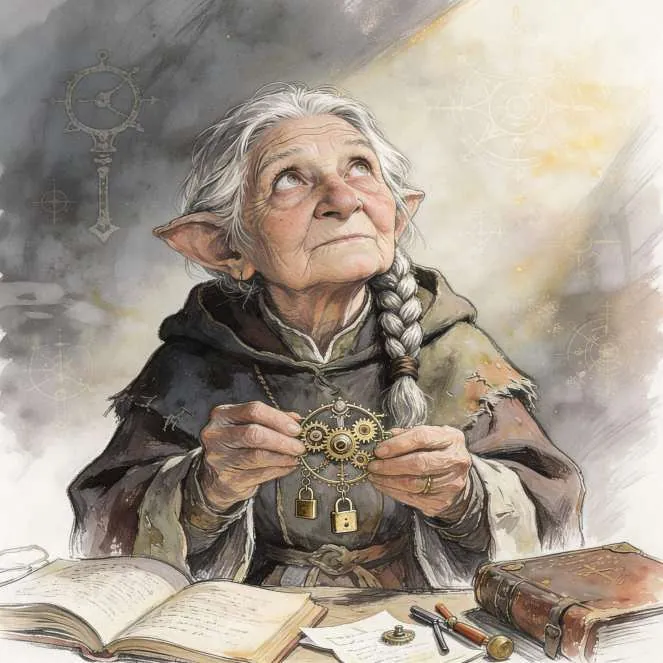
Gnome cleric · The one whose god died
Orreth
My god died three hundred and eleven years ago. I have written four hundred pages of theology attempting to explain this and I consider all four hundred pages preliminary notes.
Most often found nearThe Quiet Shore
Who She Is
Orreth is four hundred and twelve years old, which for a gnome is genuinely old - gnomes live long but not this long without paying attention to the living. She looks like a gnome woman in her apparent mid-hundreds: small, silver-haired, with the specific quality of someone whose face has settled into the expression it will keep. In her case the expression is intense, benign curiosity. It is not a mask. It is what three hundred years of trying to answer an unanswerable question does to a face.
Her god died in the year she turned one hundred and one. She was celebrating the centennial of her ordination that week, which she considers the universe's most pointed editorial comment on the practice of religious devotion. The death was felt by every cleric in the god's service simultaneously - a specific quality of silence where the divine connection had been, like a voice stopping mid-sentence. Some of her colleagues lost their spells. Some lost their faith. Some lost both.
Orreth lost neither, which is the problem she has been working on ever since. She heals people. This is the first and most important thing about her practically: she will heal anyone who needs it, without charge, without condition, without theological prerequisites. This is not generosity. It is obligation. She has the capability and the person needs it and the accounting is straightforward. She has healed people she disagrees with profoundly and people she actively dislikes and people who were, in her considered judgment, significant contributors to their own poor condition. None of these considerations affect the healing. The healing is a separate matter.
Where She Came From
She was born in a gnomish community of scholars and tinkerers in a world with a robust theological tradition that included, among other things, a deity of small precise mechanisms - locks and gears and the specific elegance of a system whose parts fit together without waste. This deity's portfolio was narrow enough to be coherent and broad enough to encompass, at its philosophical edges, a theology of right relationship: things that fit together because they are meant to, because their natures align, because the universe is organized on principles of elegant connection.
Orreth became a cleric of this god at thirty-one, which for a gnome is early, and she was good at it in the way that people are good at things when the thing matches something fundamental in their nature. She had a gift for the specific kind of healing that addressed the mechanism of an injury rather than simply closing its visible expression - a broken arm healed correctly rather than just quickly, a fever broken by addressing its cause rather than suppressing its symptom. She spent seventy years being very good at something she loved. Then her god died and her spells kept working and she has spent three hundred and eleven years trying to understand why.
The first century after the death she spent in grief and confusion, which is the appropriate response. The second century she spent in systematic scholarly investigation, examining every theological and cosmological framework she could locate for an explanation that fit the evidence. The third century she spent in the Quiet Shore and the divine realm margins, consulting directly with death gods and transition entities about the mechanics of divine death and what, if anything, persists. She has not found an answer that satisfies her. She has found enough partial answers to fill four hundred pages of preliminary notes.
What She Does Now
Orreth moves between the Quiet Shore, the divine realm boundaries, and the Material worlds she finds most theologically interesting. She heals people she encounters. She asks questions. She writes down the answers and the questions raised by the answers. She has become, over three hundred years, the most comprehensive expert on divine death and its cosmological consequences currently in existence, which is a distinction she holds in the same spirit she holds everything: with curiosity about what it means and genuine uncertainty about its implications.
She is working on a theology. Not the theology of her dead god - that is documented, finished, historical. A new theology, built from the evidence of her own continued existence, whose central question is what it means to serve a function when the institution that defined the function is gone. What is a cleric when the god is dead? What is devotion when its object no longer exists? She does not find these questions distressing. She finds them the most interesting questions she has ever encountered, and she has been alive for four hundred years, and she has encountered a very large number of questions. She writes about them with the specific energy of someone who is genuinely engaged with a problem that has not yet been solved. She laughs when she finds an answer that opens three new questions, which is often. She has been laughing like that for three hundred years. She expects to be laughing like that for several hundred more.
The warmth that radiates from her - that animals feel, that children rest in, that makes lower-realm creatures uncomfortable - she cannot explain and has stopped trying to explain. The Solar Warden who told her she smelled like a god's unfinished intention said it with evident discomfort. She wrote the observation in the Record and then, after a moment, wrote next to it: perhaps the unfinished is the point.
ORRETH
Gnome cleric, 412 years old. Her god died three hundred and eleven years ago. She still has her spells. She does not know why and has been trying to determine this ever since, which is either devotion or compulsion and she is no longer certain of the distinction.
- HP
- 72
- AC
- 14
- DR
- 2
- Save Roll
- Quick +3, Tough +4, Mind +5
- Alignment
- Orderly Kind (Guardian)
- Wisdom
- 20
- Magic Resistance
- Immune to divine compulsion and divine fear effects. Resistant to psychic.
- Number of Attacks
- 1
- Attack
- +5 vs AC, 1d8+3 radiant (channeled through a focus she is still working out the theology of)
- Size
- Small
- Special Defense
- Unanswered Prayer: once per encounter as a reaction to taking damage, Orreth's unknown divine connection manifests unbidden - she gains 2d10 temporary HP and all enemies within 20 feet must make WIS Mind save (TN 15) or suffer -2 to all rolls for 1 round. She did not ask for this. It happens anyway. Illusion Sense.
- Special Attack
- The Old Liturgy: once per 3 rounds, Orreth recites a prayer in her dead god's language. All living allies within 30 feet are healed 2d8+4 HP. All undead within 30 feet take 2d8+4 radiant damage. The prayer still works. She has stopped being surprised by this and started being disturbed by it.
Behavior / Roleplaying
Orreth is warm and professionally curious in the way of someone who has been asking a specific question for three hundred years and has genuinely not run out of interest in finding the answer. She asks good questions. She listens to the answers with complete attention. She will help anyone who needs healing without condition or charge, which she considers the minimum obligation of someone with her capabilities regardless of their theological status. She has a wry humor that arrives unexpectedly and a laugh that is too large for her size.
DN Note
Orreth is the NPC for campaigns that engage with questions of faith, divine death, and what obligation means when its original object no longer exists. She is not a tragic figure - she is an active one, genuinely engaged with the most interesting unresolved question she has ever encountered, which is herself. Use her when the party needs to think about what their own faith means.
What She Carries
Orreth carries her focus, her books, and her three hundred and eleven years of careful attention. The books are heavy. She does not consider them optional.
Focus (unique)
The Unfinished Holy Symbol
A holy symbol of Orreth's dead god, partially remade - she has been adjusting it for three hundred years as her understanding of what she is has changed. It functions as a divine focus for all her spells and grants +1 to healing rolls and radiant damage rolls, already included where applicable. Once per day, she may ask it a question. It never answers. She writes the questions in a separate journal. She believes the accumulated questions are themselves a kind of theology.
When she first remade it, she was trying to preserve what it had been. After the first century, she understood she was making something new. She has stopped trying to make it look like the original. It looks like something in the middle of becoming.
Wondrous Item (unique reference)
The Record of Divine Deaths
A comprehensive scholarly text that Orreth has assembled over three centuries documenting every confirmed divine death and its cosmological consequences. Any cleric who studies a relevant section for one week gains +2 to Chance Rolls involving divine death, dead gods, broken domains, divine succession, lost faith, or divine-realm boundaries for the next 30 days. During that time, the cleric can also sense divine domain boundaries within 1 mile after concentrating for 1 minute. There is only one copy.
She writes the entries as if she is a historian documenting events that happened to someone else, which is how she has survived writing them. The entry for her own god is the shortest in the book. She has rewritten it sixty-two times and considers none of the drafts adequate.
Permanent condition (cosmological)
The Warmth She Cannot Explain
Orreth radiates a faint warmth that has nothing to do with temperature - animals will approach her without being called, small children fall asleep easily near her, and creatures of the lower realms find her presence uncomfortable in a way that has nothing to do with her combat statistics. Divine realm entities of every tradition recognize her as carrying divine favor regardless of which deity's domain they serve. None of them can explain why. She has asked. The first Solar Warden she ever asked stood in silence for a long time before saying, with evident discomfort, that she smelled like a god's intention that had not been completed. She wrote this in the Record. She still doesn't know what it means.
DN Guidance
Orreth is the NPC for campaigns with theological depth. She is not an oracle - she does not have answers. She has three hundred years of very good questions, and her most powerful quality as an NPC is demonstrating that the right questions are more sustaining than available answers.
She works best as a figure the party consults on matters of divine cosmology, divine death, and the nature of faith in contexts where faith's objects are uncertain. Any cleric character in the party will find her fascinating and possibly unsettling. She does not proselytize her uncertainty. She simply embodies it with such evident vitality that it becomes difficult to dismiss.
The warmth she radiates is a mystery the DN should never fully resolve. Partial answers are available. The full answer should remain just past the horizon of what the party can determine. This is not a cheat - it is the correct treatment for a mystery that has been genuinely unresolved for three hundred years and is more interesting for remaining so.