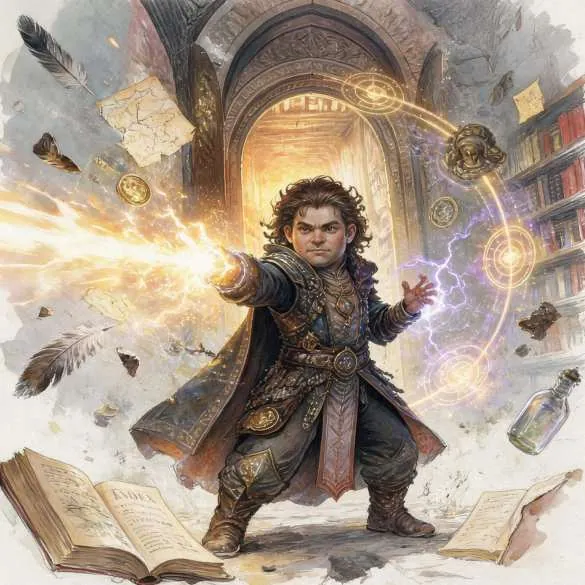
Halfling wizard · The keeper of last things
Marek Toln
Someone has to keep them. The last things. If no one keeps them then what happened to them is simply - ending. And ending without a witness is a different kind of ending than ending with one. I find that distinction important. I have found it important for forty years and I am still finding it important, which I take as a meaningful data point.
Most often found nearThe Vault of What Was
Who He Is
Marek Toln is sixty-three years old, which for a halfling puts him in the specific life stage that halflings describe as 'finding out what the point was all along' - the comfortable middle age when the energy of youth has settled into something more sustainable and the projects that will define a life have become clear. He is short even by halfling standards. He has a face that has arranged itself over sixty-three years into the default expression of someone who has just heard something interesting, which is accurate because he nearly always has. He collects last things. This is not the first sentence he would use to describe himself, because the description he would use is longer and more specific and involves a great deal of context that he cannot provide in one sentence without losing what he considers the essential quality of the project. The essential quality is this: not everything that ends is remembered. Most things that end are not remembered. The last speaker of a language, the last practitioner of a tradition, the last physical object from a destroyed civilization - these end, and the ending is simply the ending, and nothing marks it, and the world continues with something missing that most of the world does not know was there.
Marek marks it. He has been marking it for forty years. He has six hundred objects, testimonies, recordings, and living things in his demirealm repository, each one the last of something. He is professionally charming and genuinely interested in people and has a gift for making whoever he is talking to feel that the thing they just said was exactly the thing he needed to hear. These qualities have served his project well. He is aware that they serve his project well. He is also aware that he actually is interested in people and actually does find the things they say valuable, and that the distinction between using something and doing it naturally is the kind of distinction that becomes harder to maintain clearly over forty years of practice.
Where He Came From
He was born in a halfling community in a fertile valley in a world he remembers with the specific combination of fondness and distance that comes from a childhood that was genuinely good and genuinely complete - a place he loved and left because he had used up what it had to teach him. His family were gardeners: not metaphorically, not as a cultural archetype, but literally - they grew things, carefully, with specific knowledge of what each thing needed to thrive. He learned from them the practice of understanding an individual thing's requirements before attempting to meet them. This is the foundational skill of everything he does.
He was twenty-three when he found the first last thing: a song. He was traveling between cities in his home world, passing through a village during a festival, and he heard an old woman singing a song in a language he could not identify. He asked, afterward, what language it was. She told him it was the language her grandmother's grandmother had spoken, that she was the only person left who knew any of it, and that she did not know anyone to teach. He sat with her for two weeks and recorded everything she knew. She died the following spring. He has carried the record of that language for forty years. That was the first. He did not understand at twenty-three that he was beginning something. He understood it at twenty-seven, when he found the second, and at thirty-one when he found the third and realized he had been systematically looking without knowing he was looking. By thirty-five he had twelve objects and the beginning of the Index and the demirealm and the understanding that this was his life's work - not one of his interests, not a compelling project, but the thing he was for.
He has spent the forty years since getting better at finding last things, which requires a comprehensive knowledge of what exists in order to identify what is ceasing to exist. This requirement has made him, by necessary consequence, one of the more broadly knowledgeable people in any realm he visits. He knows what is current and what is historical and what is the specific status of things at the border between the two. He is careful about this knowledge - careful in the way that a person who knows how quickly last things become lost things is careful.
What He Does Now
Marek Toln moves between realms with the agenda of someone who has a specific list and has been working through it for forty years. He is looking, currently, for three things: the last speaker of a language that has no recorded name, which he has been tracking for six years through a chain of secondhand references that keep almost converging; the last physical artifact of a divine domain whose god ascended entirely beyond the oblong's structure three centuries ago, which is an unusual enough theological event that the objects connected to it should be extraordinary; and someone who understands, fully, what he is doing and why. The third item is the one he added to the list most recently. He is sixty-three years old and has been doing this work alone for forty years and he has become aware, gradually and then suddenly and then as an established fact he cannot un-establish, that the work is incomplete in a specific way. He can record last things. He can preserve them with extraordinary care in his demirealm. He cannot witness them. Witnessing requires someone else. The old woman's song is preserved in his records as faithfully as he could manage, but he was twenty-three and she sang it to him in a village he was passing through and he sat with her for two weeks and then she died and he has been the only person who heard that song for forty years.
He is working on this. He approaches it the way he approaches everything: with charm and genuine curiosity and patience and the specific strategic intelligence of someone who has spent forty years finding things that do not want to be found. He is currently traveling with more frequency than usual between the Material worlds and the Vault of What Was, looking for something he cannot quite name yet, which he has learned over sixty-three years is the reliable sign that he is close to finding it.
The empty shelf in his demirealm is for the thing he has known he was looking for since approximately eleven years ago, when he found the artifact that would sit next to it and understood from the artifact's nature what the space beside it required. He has not discussed this with anyone. He has not written it in the Index. He is, for the first time in forty years of meticulous documentation, keeping something to himself. He is not sure what this means. He finds it, as he finds most things he does not understand about himself, genuinely interesting.
MAREK TOLN
Halfling wizard, 73 years old. Has a demirealm he uses as a repository. Is currently looking for three specific things: the last speaker of a language with no name, the last physical artifact of a divine domain whose god ascended beyond the oblong's structure entirely, and someone who knows why he is doing this. He has not found the third yet.
- HP
- 40
- AC
- 13
- DR
- 0
- Save Roll
- Quick +3, Tough +2, Mind +4
- Alignment
- Orderly Impartial (Arbiter)
- Intelligence
- 18
- Magic Resistance
- Resistant to memory and knowledge-based effects. Cannot be made to forget something he has deliberately chosen to remember.
- Number of Attacks
- Spellcasting: Marek
- Attack
- +6 vs AC, 2d8+4 force (a spell he designed specifically for quick, efficient, minimally destructive application of force - he considers lethal combat wasteful and architecturally uninteresting)
- Size
- Small casts as an 8th-level wizard. He knows wizard spells up to 8th level, along with additional rare spells he has created, collected, or deciphered.
- Special Defense
- I Have One of Those: once per encounter, when Marek would be affected by any magical effect, he may reach into his demirealm and produce a counter-item or relevant protective artifact, reducing the effect by half. He always has something. This has disturbed people who thought they had a novel approach. Lucky.
- Special Attack
- The Last Example: once per encounter, Marek may describe something in precise scholarly detail - a creature's weakness, a spell's exact mechanism, a location's specific vulnerability. The subject of the description takes 3d8 force damage and is treated as having -3 to all defenses against the party for 2 rounds. He has had sixty-three years to become extremely precise.
Behavior / Roleplaying
Marek Toln is professionally charming in a way that takes a minute to identify as professional. He is interested in you. He is genuinely interested in you. He will ask good questions and listen to the answers with complete attention and remember everything you tell him and never be tedious about it. This is all real. It is also the behavior of someone who has discovered that people who feel genuinely seen tend to tell you things. He is not manipulative, exactly. He is a person whose natural inclinations happen to produce the outcomes of manipulation without the intent.
DN Note
Marek is the most complex NPC in this book to run because his motivations are the most opaque - even to him. He is charming, helpful, genuinely interested in the party, and pursuing a project whose full scope he has not explained to anyone. The question of what happens when he has assembled everything he is looking for is the DNs to answer. Make it something that takes the party by surprise in a way that, in retrospect, was inevitable.
What He Carries
Marek carries more than is visible. The floating objects that orbit him when he is at rest are not a magical effect - they are things he is currently thinking about, externalizing the way some people pace. The three items documented here are the significant ones.
Wondrous Item (unique)
The Demirealm Key
A small brass key, apparently ordinary, that opens a specific door frame Marek carries with him. When the frame is set up and opened with the key, it leads into his private demirealm repository. The demirealm contains approximately six hundred objects, organized by a system only Marek fully understands. The key does not work for anyone else, and the door frame without the key is just a door frame.
He found the demirealm empty and unclaimed and moved into it the way a hermit crab moves into a found shell - not by building but by recognizing a fit. He has been filling it for forty years. He considers it his most significant ongoing project and his home. The second of these is something he admitted to himself only recently.
Wondrous Item (unique reference)
The Index
A small leather-bound book that is an index of everything in Marek's demirealm repository, cross-referenced by type, origin, age, and Marek's personal significance rating. Once per day, a reader of the Index may ask it one question about the current status of any last surviving example of a category of thing. The Index knows. It answers in Marek's handwriting.
The Index updates itself, which Marek discovered three years after he started writing it. He does not know how. He considers this the most interesting thing about it. He has written this in the Index under his own name: 'Marek Toln: the most interesting thing about him may also be something he does not understand about himself.'
DN Guidance
Marek Toln is the most naturally useful NPC in this book for a Dungeon Narrator because his resources and his project create hooks rather than consuming them. He knows where things are. He needs things found. He has a demirealm full of objects that might be exactly what the party needs and that he will loan under specific conditions. He is charming enough that players will enjoy talking to him before they understand what he is doing. The empty shelf is the long game. It is the thing the DN plants early and pays off late. What belongs on the empty shelf should be determined before Marek is introduced to the campaign, and it should connect to something in the party's story - not their quest, specifically, but something about who they are or what they represent. The moment Marek sees the party and understands the connection is the moment the shelf comes up. Not before.
He is not a villain. He is not secretly sinister. He is a halfling wizard who has spent forty years keeping last things because someone has to, and who has recently understood that keeping things alone is not actually keeping them - it is just postponing the forgetting. What he wants from the party, ultimately, is witnesses. He wants people who know what he has and why it matters. The party may find this either straightforward or the most complicated gift they have ever been offered, depending on who they are.