Realms GuideAtlas of the Infinite
OpenDungeons

Chapter 11

Travel and the Realms

Moving between the realms of the Multirealms is not as simple as stepping through a door. It is a negotiation between what you are and where you are going, mediated by the Ethereal, assessed by the Gate Keepers, and limited by the physical reality of your mortal body. Some crossings are trivial. Others are the most dangerous thing a character will ever attempt.

This chapter explains the practical mechanics of planar travel - how each method works, what crossing feels like, how different classes handle the journey differently, how to survive once you arrive, and what happens when the trip goes wrong.

The Multirealms is infinite. You can go anywhere. Whether you survive the going is a different question entirely.

Methods of Travel

Five Ways to Cross

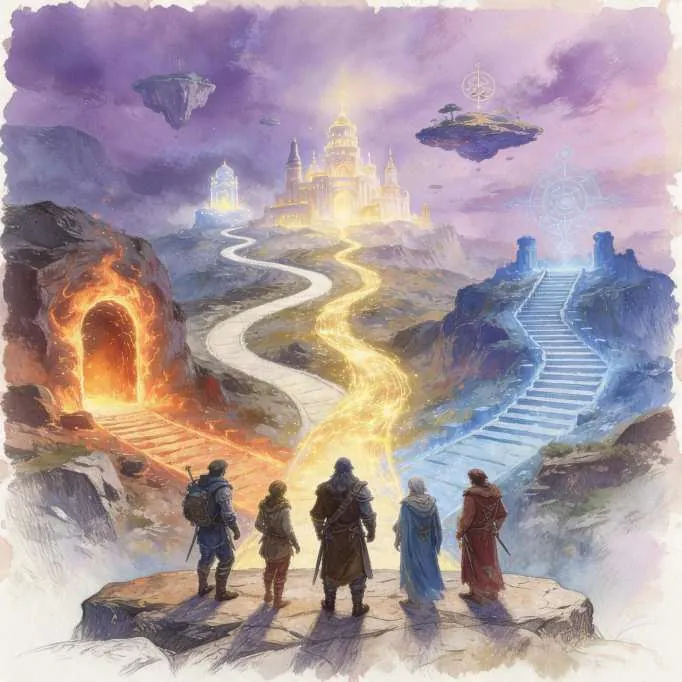
Not all planar travel is equal. The method you use determines the experience of crossing, the risks involved, and what the Gate Keepers make of your passage.

Method 1 of 5

Portal Transit

World to world. Instant Ethereal transit. Shortest possible exposure. Gate Keepers rarely engage sanctioned portals.

The safest form of planar travel. When a party uses a portal, ley line, or vortex to move from one Material world to another, they are moving horizontally through the Ethereal membrane - never leaving the Material's resonance tier, simply relocating within it.

Portals are the cleanest crossing. Someone created them with intent, embedded a destination into their structure, and the resonance key is built into the arch or the activation mechanism. Step through, feel the briefest sensation of the Ethereal - a single breath of silver mist, a moment where your shadow is in a different place than your body - and you arrive. Gate Keepers rarely intervene in portal crossings unless the portal is malfunctioning or the traveler lacks the resonance the portal's creator encoded.

Method 2 of 5

Ley Line Travel

Riding accumulated magical energy. Slower. Imprecise. Rich with Ethereal experience.

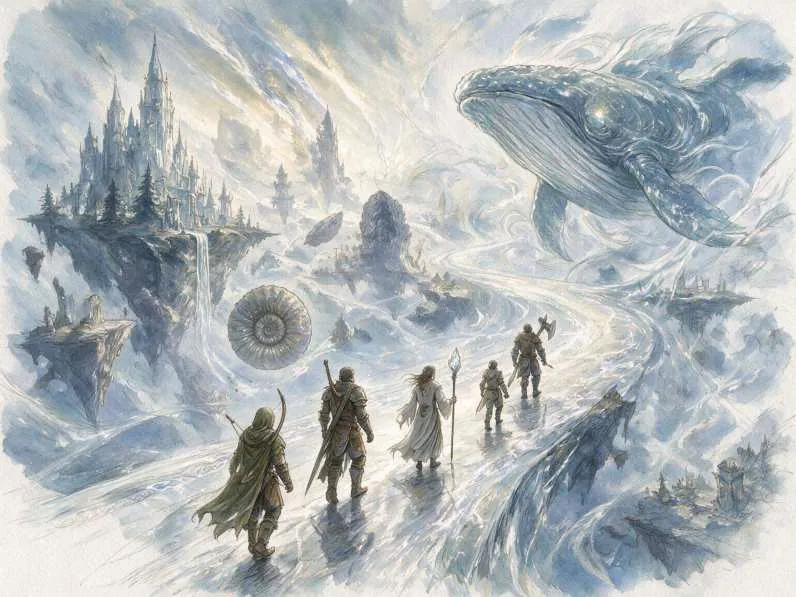
Ley line travel is older and less predictable. Ley lines are natural channels of accumulated magical energy threading through the Material Realm - the veins in the world's body. Attuning to a ley line and riding it to another confluence point takes time (typically hours, not minutes), requires concentration and a baseline magical sensitivity, and has a meaningful chance of producing arrival slightly off from the intended destination. The experience is a sustained low-level Ethereal immersion - travelers see flickering impressions of the worlds adjacent to the ley line's path, feel the emotional residue of the magic that has flowed through it, and arrive with the specific mental texture of someone who has been thoroughly washed.

Method 3 of 5

Vortex Crossing

Ancient natural thresholds. Directional. Seasonal. Not always reliable. Connects paths that portals do not.

Vortexes are ancient, natural threshold points where Material realities press close enough together to be accessible - old battlefields that happened in two worlds simultaneously, sacred sites where different cultures independently decided the same location was holy, geographic features that share resonance across the Ethereal membrane. Vortex travel is not reliable by human standards. The passage may be open only at certain times, or only to certain types of travelers, or only in one direction. But vortexes predate every civilization that has ever mapped them, and they connect some paths that no portal or ley line covers.

Method 4 of 5

Resonance Shift

Leaving the Material entirely. Always passes through Gate Keeper assessment. The physical experience of crossing changes reality.

Crossing out of the Material Realm altogether - entering the Ethereal, ascending toward divine domains, descending into lower realms, or reaching specialty realms - is a fundamentally different kind of travel. The traveler is not merely relocating within a resonance tier. They are changing which tier they occupy.

The physical experience of a resonance shift is distinctive enough that experienced planar travelers can identify it in retrospect - a qualitative change in the sensory texture of the world around them. Material reality has a particular denseness: the air has friction, light has direction, silence sounds like something. As a traveler shifts resonance, these qualities change. Moving toward divine domains, reality becomes lighter - not physically but experientially, as if the specific gravity of consequence decreases and possibility increases. Moving toward lower realms, reality becomes heavier. Not the heaviness of fatigue but the heaviness of the specific knowledge that things tend toward dissolution and not much can be done about it.

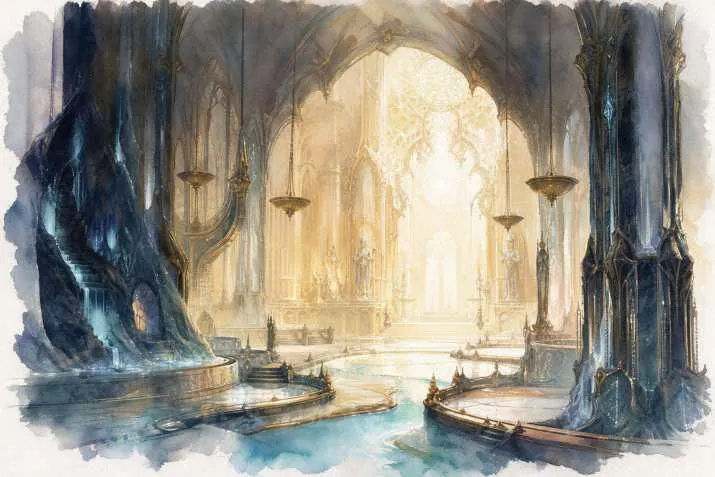
Resonance shifts always pass through the Ethereal. There is no shortcut around the membrane. Every journey from the Material to any other realm includes an Ethereal transit period, even if it is brief. This is the moment of Gate Keeper assessment. Most sanctioned crossings - divine spells, proper portal use, authorized magical transit - move through this period so quickly that travelers only experience it as a heartbeat's worth of silver mist. Unauthorized crossings linger.

Method 5 of 5

Astral Travel

Consciousness without body. Navigation by intent. Body remains vulnerable. Extended separation thins the traveler.

The highest form of planar mobility and one of the most dangerous. Astral travel separates the traveler's consciousness from their body - the body remains behind in a protected state while the mind moves through the Astral layer of the Ethereal and from there to any destination in the Multirealms.

The advantages are significant: consciousness traveling astrally does not require the body to survive the resonance shifts that physical travel demands. A mortal body ascending toward a divine domain might begin to dissolve in the intensity of the resonance shift. A consciousness traveling astrally can navigate the same journey as pure awareness and experience none of the physical consequences.

The disadvantages are equally significant. The body left behind is vulnerable. Standard bodily maintenance ceases - the body does not eat, breathe, or respond to danger during astral projection. In safe locations, a few hours of astral travel poses no risk to the body. In dangerous locations, leaving the body unattended is leaving it undefended.

Additionally, a consciousness separated from its body for extended periods begins to thin. The Ethereal is happy to absorb wandering minds gradually, the same way water gradually absorbs warmth from a cooling object. Astral travelers returning from extended journeys sometimes find that they need to spend time consciously reconnecting with material existence - eating, handling physical objects, engaging in sensory activity - before they feel fully anchored again.

Navigation in the Astral is by intent. You do not swim through space. You aim at a destination - a place you know, a person you recognize, a concept you understand well enough to reach - and you move. The more clearly and specifically you can picture your destination, the more reliable the arrival. Vague destinations produce vague arrivals. A wizard who thinks 'I want to reach a divine realm' may arrive in any divine domain at all. A cleric who thinks 'I want to reach the hall of judgment in my deity's domain, specifically the hall where the golden scales hang and the feathers of truth are weighed' will arrive precisely.

The Physical Experience of Crossing

What It Feels Like

Every type of planar crossing has a physical and psychological texture. Experienced planar travelers develop a vocabulary for these experiences. First-timers are typically too disoriented to describe them accurately until afterward.

Portal Transit

The briefest of crossings. A heartbeat of silver mist. A sound like a word in a language you don't speak but almost understand. The sensation that you are in two places simultaneously for a fraction of a second, and then you are only in the new one. Some people find this pleasant. Some find it nauseating. The difference appears to be constitutional rather than psychological - some bodies handle discontinuity better than others.

Ethereal Immersion

Entering the Ethereal deliberately produces a sustained version of the portal transit sensation. The mist that was a heartbeat during portal use becomes the environment. Vision becomes doubled - Material world impressions layered over Ethereal reality, with neither quite solid. Sound behaves incorrectly: some sounds are louder than they should be, others muffled or absent. The traveler's own body is slightly translucent when they look at their hands. After a few minutes, most people adapt. After a few hours, the Ethereal starts to feel normal, which is the first warning sign.

Ascending Toward Divine Realms

The body becomes lighter, but this is not comfortable in the way physical lightness is comfortable. It feels more like certainty becoming optional - like the walls of your sense of self are becoming permeable. Experienced travelers describe it as the feeling of being held to a great intensity of attention. Less experienced travelers sometimes panic at this stage, and panic in a resonance shift is dangerous because strong emotion given physical form is exactly what the Ethereal produces given any encouragement.

As the traveler moves higher into the divine resonance, colors become more vivid than colors in the Material. Light does not come from a source but from everywhere. The sound of the traveler's own thoughts becomes audible - not as an external voice, but as a clear interior presence that is suddenly much more difficult to ignore than it normally is.

Descending Toward Lower Realms

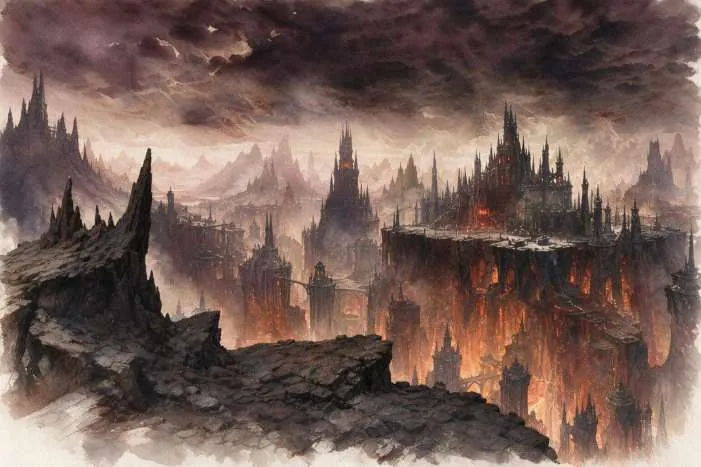
The opposite. The body becomes heavier in the specific way that bad news feels heavy. Colors don't become less vivid - they become more so, but in the wrong direction, leaching toward shadows. The traveler's own hope becomes perceptible as a texture, a quality of the air around them, and that quality diminishes with each step deeper. Experienced travelers who have made this journey describe the key practice as keeping something to think about: a purpose, a person waiting for them, a task that must be completed. Abstract hope does not survive the descent. Specific, concrete, particular things to do - those hold.

Class-Specific Travel Notes

Not All Travelers Cross the Same Way

Not all travelers navigate the Multirealms the same way. A character's training and fundamental nature shape how they experience and survive planar transit.

The natural planar travelers of the Material Realm. A cleric's divine connection is, at its core, a maintained Ethereal thread between the cleric and their deity's domain. They have been managing a low-level resonance connection their entire adventuring career. Full planar transit is an amplification of something they are already doing.

Clerics navigating toward divine realms aligned with their deity find the crossing significantly easier - the resonance key is built into their faith, and the Gate Keeper often reads the divine connection itself as sufficient sanction. Clerics ascending toward their own deity's domain may notice the Gate Keeper's presence only as a warmth and a brief sense of recognition, rather than the full weighing other travelers experience.

In lower realms, a cleric's divine connection provides meaningful psychological protection. The thread of divine resonance is a reminder that the lower realm is not the only reality - that somewhere, hope is not a structural weakness. This does not eliminate the lower realm's environmental pressure, but it creates a tether that keeps the cleric anchored to their own values and sense of purpose in a way that purely mundane travelers lack.

Understand the Ethereal mechanically. A wizard who has studied planar theory can navigate the Ethereal the way a navigator uses charts - not by instinct but by knowledge, working systematically through the current position and applying known principles of Ethereal physics to reach the intended destination.

Teleportation spells encode this mechanical knowledge in their spell-form. The wizard constructs a destination in precise magical language, and the spell dissolves the caster through the Ethereal with a resonance key built from that precision. Sloppy destination encoding produces sloppy arrivals. Precise destination encoding, especially for locations the wizard has personally visited and can recall with accuracy, produces precise arrivals. In divine realms, wizards often experience profound disorientation - not from the resonance shift itself but from encountering a reality where their mechanical understanding of magic simply does not apply. The frameworks they use to organize arcane knowledge are based on Material physics, and the divine realms do not share that physics. Wizards who have studied theology alongside arcane theory navigate this better than those who haven't. The experience is humbling in a useful way.

Physical training does not translate into planar resilience in any direct sense. A fighter does not cross the Ethereal more easily because they can run farther or lift more. But certain qualities that physical training produces do matter: the ability to endure discomfort without fixating on it, the discipline to maintain a specific mental focus under difficult conditions, the capacity to continue functioning when the environment is deeply unfamiliar. In lower realms, fighters often adapt more readily than expected. The physical hardship that lower realms emphasize is something they have spent years training to endure. The psychological pressure is the harder challenge - a fighter whose survival has always depended on being able to reliably read a physical environment will find lower-realm reality more disorienting than lower-realm weight.

A Level 10 Ascended fighter, specifically, has a cosmological presence that divine realm entities recognize even before any formal introduction. The aura of a completed mortal story is unusual enough in divine space that Wardens and Arbiters may approach with curiosity rather than suspicion.

Natural threshold-readers. A thief's professional attention to the difference between surfaces - what is solid and what will give, what is watched and what is not, where the gaps are - translates with surprising directness to Ethereal navigation. The Ethereal is full of gaps. A thief's instincts tell them where.

In the Realm of Dream specifically, thieves adapt to narrative logic faster than most other classes. Thieves are already accustomed to operating within a world organized around what people believe is happening rather than what is actually happening. Dream logic is an extreme version of a dynamic they have been navigating professionally since Level 1.

Survival Requirements by Realm

What You Need to Stay Functional

The realms of the Multirealms are not uniformly survivable. What you need to stay functional varies enormously by destination. The following covers the primary hazards and minimum preparations for each major realm tier.

Natural Thresholds

How to Find Them

Not all crossings require constructed portals or powerful spells. The Multirealms is perforated with natural thresholds - places where the Ethereal membrane has grown thin through long use, geographic coincidence, or the accumulated weight of human significance.

Ley line confluences are the most reliable natural thresholds. Where two or more ley lines meet, the accumulated magical energy creates a natural thinning in the Ethereal membrane. These confluences are typically marked by generations of use - prehistoric stone circles, sacred groves, ancient battlefields, the sites of significant magical events. A traveler with magical sensitivity (any spellcaster, or a thief trained to read magical environments) can detect a ley line confluence within roughly half a mile.

Places where death has concentrated are natural lower-realm thresholds. Not places where single deaths have occurred - mass casualties, places where many died with strong shared emotion, locations of ongoing suffering. The accumulated weight of those deaths creates a natural thinning in the direction of the lower realms. This is why ancient battlefields are cosmologically significant: they are natural lower-realm access points, and the creatures that use them treat them accordingly.

Places of profound regular worship - not grand temples (which are constructed thresholds) but sites where genuine, sustained, deeply felt devotion has occurred over generations - develop natural thinning toward the relevant deity's domain. A small shrine that has been genuinely prayed at every morning for three hundred years may have a more accessible divine threshold than an enormous cathedral built as a political statement. Demirealm boundaries are their own category of natural threshold. Every demirealm has a border, and that border is, by definition, a place where Material and Ethereal are already mixed. Entering the Ethereal from inside a demirealm is significantly easier than entering from ordinary Material space - the membrane is already compromised.

Failure Modes

When Things Go Wrong

Planar travel has failure modes. Some are inconvenient. Some are fatal. Experienced planar travelers develop contingency habits the same way experienced dungeon delvers develop torch-lighting protocols.

Mis-aimed Teleportation

The most common serious planar travel failure. A teleportation spell with imprecise destination encoding may produce any of the following: arrival in the correct general area but wrong specific location (usually harmless, occasionally embarrassing, sometimes into walls); arrival in the correct dimension but the wrong world entirely (survivable if the world has breathable air); arrival in the Ethereal rather than the destination (lost, but alive, and the Ethereal is at least navigable); or arrival partially inside a solid object (this is fatal). The DN should scale mis-aimed teleportation to the precision of the spell's construction and the caster's level. A Level 9 wizard teleporting to a location they have visited thirty times should rarely fail catastrophically. A Level 4 wizard teleporting to a description from a book has significantly more room for the story to create complications.

Gate Keeper Refusal

A Gate Keeper that refuses passage does not kill the traveler. It holds them. The traveler exists in a suspension state at the threshold - unable to proceed, unable to return without the Gate Keeper's decision, but not in immediate danger. The suspension can last moments or what feels like years.

Gate Keeper refusal is not punishment. It is assessment. A traveler held at a threshold needs to provide what the Keeper requires - truth, clarity of purpose, adequate resonance preparation, or the understanding that they are not ready for their destination and should return to complete their preparation. The correct response to Gate Keeper refusal is never violence. The correct response is attention to what is actually being asked.

Resonance Incompatibility

When a traveler enters a realm whose resonance is too far from their own for safe occupation - a purely Material-oriented character attempting to enter the deepest divine domains without preparation, for example - their body and soul begin to diverge. The physical body resists the new reality (unable to properly exist in a place where belief shapes matter and physics doesn't govern). The soul is pulled toward the new resonance (because souls are resonance-based entities and will always tend toward alignment with their environment).

Early signs: confusion about which things are real, difficulty maintaining a consistent sense of personal identity, perceptions from the destination realm bleeding into normal sensory experience. Late signs: the body and consciousness operating on different assumptions about reality. DN intervention is appropriate here - this is a story moment, not a mechanical one, and the resolution should reflect the character's specific nature and situation.

Soul-Body Separation During Astral Travel

During astral travel, the body remains alive but inert, like a lamp with its flame elsewhere. It must be guarded, because harm to the body can strand the traveler's consciousness beyond the Material.

Time does not always pass evenly between the Astral and the Material body left behind. In shallow Astral travel, the difference is usually minor - minutes remain minutes, hours remain hours. In deeper Astral currents, especially near divine domains, lower realms, old demirealms, or Gate Keeper thresholds, subjective time may stretch or compress dramatically. A traveler might experience a day of wandering, conversation, or trial while only minutes pass around the physical body, or return from what felt like a brief crossing to find that hours have gone by. The DN decides the exact relationship, but astral time should always feel slightly untrustworthy once the traveler moves far from the Material anchor. The most dangerous failure specific to astral projection occurs when the traveler's body is killed while their consciousness is traveling astrally. If this happens, the consciousness cannot return. The soul continues in the Astral or moves toward the appropriate afterlife. This is not immediate death - it is a state of genuine cosmic crisis, as the person still exists as consciousness but has no body to return to.

If the traveler's astral connection is severed by hostile action - certain creatures and magical effects can cut the cord between astral consciousness and physical body - the consciousness is immediately lost in the Ethereal and must find its own way back to the body (which typically regains consciousness when the connection is severed, disoriented and Weary). This is recoverable but harrowing.

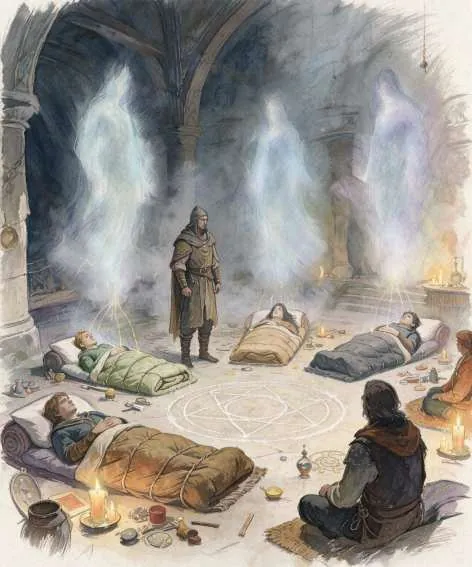
Precaution: never leave a body unguarded during astral projection. Ideally, leave it in a location with a companion specifically tasked with protection. The Gate Caller's Horn, held by the guardian, allows them to summon Gate Keeper attention if the body is threatened - an extreme measure, but available.

Gear, Weapons and Traveling

Selves, Not Inventory

Travelers asleep while their astral forms stand watch

The simplest rule is this: when the body travels, the gear travels with it. When only the consciousness travels, physical gear stays behind.

A character who steps through a portal, rides a ley line, or passes through a vortex carries what they are wearing and holding, unless the crossing specifically rejects it. Armor, weapons, packs, coins, relics, spellbooks, and holy symbols travel with the body because the body itself has crossed.

Portals are usually the cleanest form of travel for equipment. A properly made portal carries the traveler and their immediate possessions as one complete physical presence. The sword at the belt, the cloak on the shoulders, the pack on the back, and the ring on the finger all pass through as part of the traveler's Material pattern. The portal's resonance key decides what belongs to the traveler and what does not. A worn amulet passes easily. A wagon full of stolen temple bells may not.

Ley line travel also carries physical gear, but less neatly. Because ley lines move travelers through natural magical channels rather than crafted doors, carried objects may pick up residue from the journey. Metal may feel warm, cold, or faintly humming. Ink may blur and settle again. Food may taste slightly different. Most of these effects are harmless, but sensitive relics, cursed items, divine objects, or lower-realm materials may react strongly to the current being traveled.

Vortex travel is the least predictable. A vortex is not built to serve travelers; it is a natural threshold where realities press close together. Most of the time, gear travels with the body, but the DN may decide that certain objects arrive changed, delayed, marked, or rejected if they do not match the nature of the crossing. A blade carried into a realm of peace may grow heavy. A holy symbol taken through a lower-realm vortex may burn cold against the skin. A stolen relic may arrive before its thief, waiting in the dust like an accusation.

Astral travel is different. During astral projection, the traveler's consciousness leaves the body, but physical gear remains behind. Weapons, armor, packs, coins, tools, scrolls, spellbooks, and ordinary relics do not travel into the Astral unless a specific spell, item, or realm effect says otherwise. The body remains where it was placed, surrounded by the traveler's real possessions, vulnerable to theft, damage, or interference.

An astral form may still appear clothed, armored, or armed, but these appearances are expressions of identity, memory, faith, and training. A fighter may appear with a ghostly version of their trusted sword. A cleric may appear with the symbol of their god shining at their chest. A thief may appear with spectral tools at their belt. These are not physical items. They are the traveler's idea of themselves given temporary shape.

The DN decides what astral gear can actually do. In most cases, astral weapons and armor function only as part of the traveler's spiritual presence, not as true equipment. A warrior's astral blade may allow them to fight astral threats because the warrior's will knows itself through the weapon. A wizard's astral spellbook may appear as pages of memory, but losing it does not destroy the real spellbook beside the body. A cleric's astral holy symbol may carry real devotional force because faith is not purely physical.

Some items are exceptions. Certain relics are made specifically to cross boundaries of body and spirit. A Gate Keeper's Seal, astral stone, divine shard, dream-lens, soul-chain, or similar object may project an echo of itself with the traveler, or may allow its power to be invoked from the body's side of the connection. Such items should be rare and clearly noted. Ordinary gear stays with the body. Realm-touched relics may bend that rule. This distinction matters because travel should have consequences. A party entering a portal is still physically armed. A party riding a ley line still carries its packs. A party stepping into a vortex may bring everything and still arrive changed. But a party traveling astrally leaves its steel, rations, armor, and sleeping bodies behind. They enter as selves rather than as inventory.