There was a period in tabletop fantasy publishing when supplements were written less like reference catalogs and more like serious articles on craft. Products were presented not merely as collections of content, but as arguments for how play itself should feel. Open Dungeons RPG - 92 Traps to Die For belongs naturally in that tradition because it is not simply a numbered inventory of hazards. It is, at its core, a design statement about what traps are supposed to accomplish inside a dungeon.
Rather than treating traps as isolated bursts of damage or arbitrary punishment, the volume approaches them as structural parts of architecture, atmosphere, and decision-making. The result is a collection that restores danger to the dungeon in a way that feels deliberate rather than decorative.
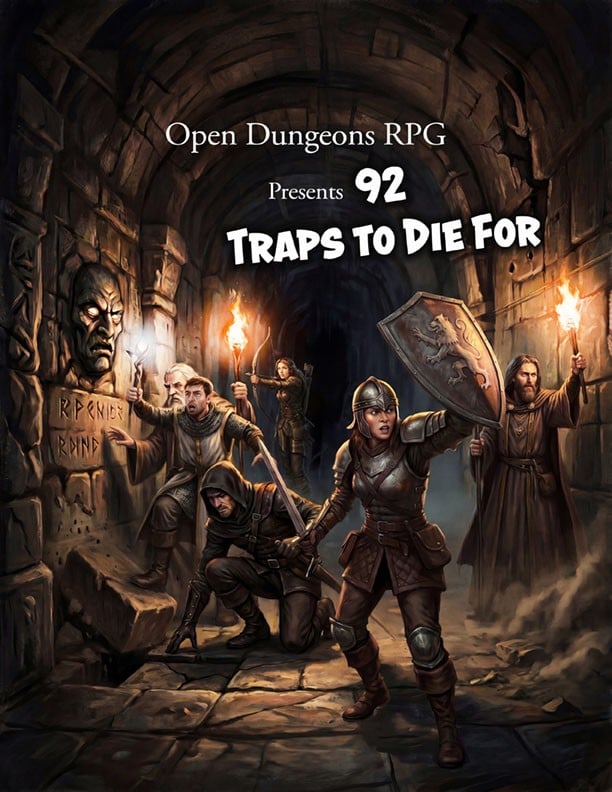
Purchase for $7 or free with Patreon support of $3/mo - https://www.patreon.com/c/opendungeons
The strength of the work begins with discipline. Each trap is presented through a fixed framework that immediately establishes practical clarity: type, threat, purpose, detection, trigger, effect, countermeasures, and reset. That structure matters more than it first appears. In many trap books, the reader is given an interesting concept but left to solve implementation alone. Here, every entry already understands that a trap must answer several questions before it becomes playable. How is it noticed, if at all? What exactly activates it? Can intelligent players interfere with it? Does it remain dangerous after activation? Because those questions are answered every time, the book becomes usable during live play rather than merely inspirational. The entries are written with the assumption that the Dungeon Narrator may need to deploy them immediately, without rewriting mechanical logic at the table.
The collection is divided across mechanical, magical, and hybrid constructions, and this division gives the volume unusual tonal range. Mechanical traps rely on engineering, gravity, tension, counterweights, hidden channels, blades, crushing surfaces, chains, pressure, and carefully concealed movement. Magical traps operate through wards, curses, enchanted triggers, and supernatural retaliation.
The hybrid category proves especially interesting because it introduces traps in which the physical and arcane coexist inside a single object or room. This allows the dungeon itself to feel authored by cultures of different technical character: dwarven vaults, forgotten temples, wizard-built passages, military strongholds, and burial complexes all emerge naturally from the material because the traps imply builders.
What distinguishes the book from generic hazard supplements is that very few of its traps exist merely to surprise. Most are visible in some form before they are understood. This is a much older and stronger philosophy of dungeon construction. A player should often be allowed to see danger before fully grasping its meaning. The room itself becomes suspicious, and tension begins before activation. Chains hanging from a ceiling, grooves worn into stone, carvings around a keyhole, unusual dust patterns, or subtle asymmetry all become invitations to caution. The text repeatedly rewards observation over luck, which means traps generate atmosphere before they generate consequence.
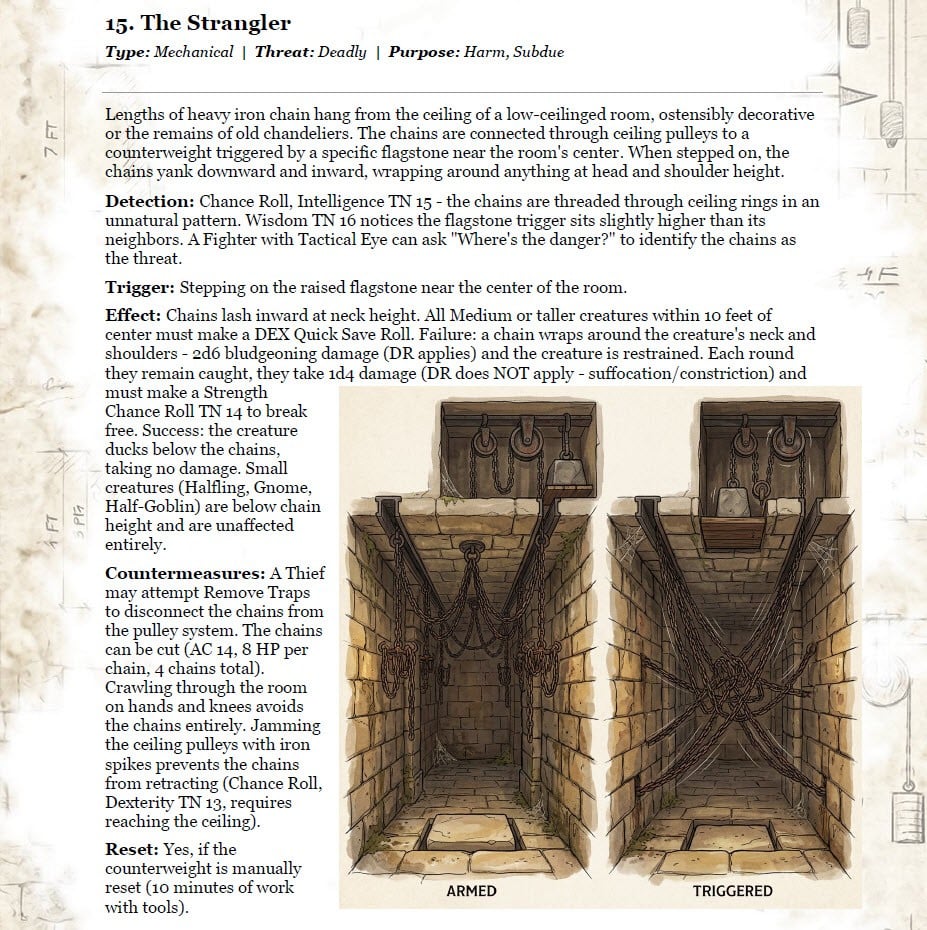
A clear example of this principle appears in The Strangler, one of the stronger mechanical entries in the collection. The room presents lengths of heavy iron chain suspended from a low ceiling, apparently decorative or perhaps remnants of broken chandeliers. Nothing in the chamber initially declares immediate danger. Yet the central flagstone is raised slightly above its neighbors, and stepping upon it releases a concealed counterweight that pulls the chains sharply inward and downward. The chains strike at neck and shoulder height, wrapping around medium and taller creatures caught within range. What makes the trap especially effective is that its logic is physically legible after the fact. Once triggered, players understand exactly why it happened, which gives the event credibility. The design also avoids monotony by allowing body size to matter. Smaller creatures pass beneath the danger naturally, while taller characters become vulnerable by proportion alone. Even before activation, the room encourages altered movement. Crawling, crouching, probing with poles, or examining ceiling rings all become rational responses, which means the trap succeeds before it ever harms anyone because it changes player behavior.
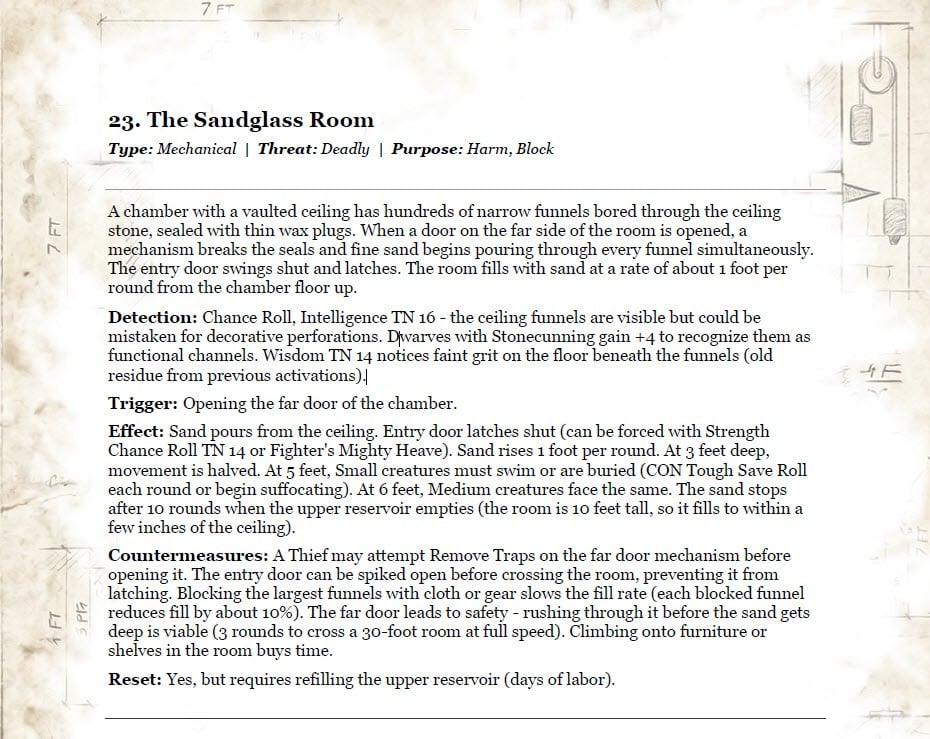
If The Strangler represents spatial restraint and concealed force, The Sandglass Room demonstrates another principle entirely: escalating environmental pressure. This chamber is built around delayed panic rather than sudden injury. Its ceiling contains hundreds of narrow funnels sealed with thin wax plugs. When the far door opens, a mechanism breaks the seals and sand begins pouring from above in a simultaneous downward cascade. The entry door then swings shut and latches. Sand rises steadily at roughly one foot per round, altering movement long before it becomes lethal. At shallow depth, progress slows; later, movement becomes a struggle, and eventually suffocation threatens those trapped within. The trap succeeds because it transforms the room itself into a timed encounter. A chamber that initially appears empty becomes a narrowing vertical problem in which every decision acquires urgency. Players may rush for the far exit, attempt to block funnels, wedge the door, climb furniture, or exploit height. What matters is that the trap produces thought under pressure rather than merely subtracting health. It is architectural drama rather than impact damage.
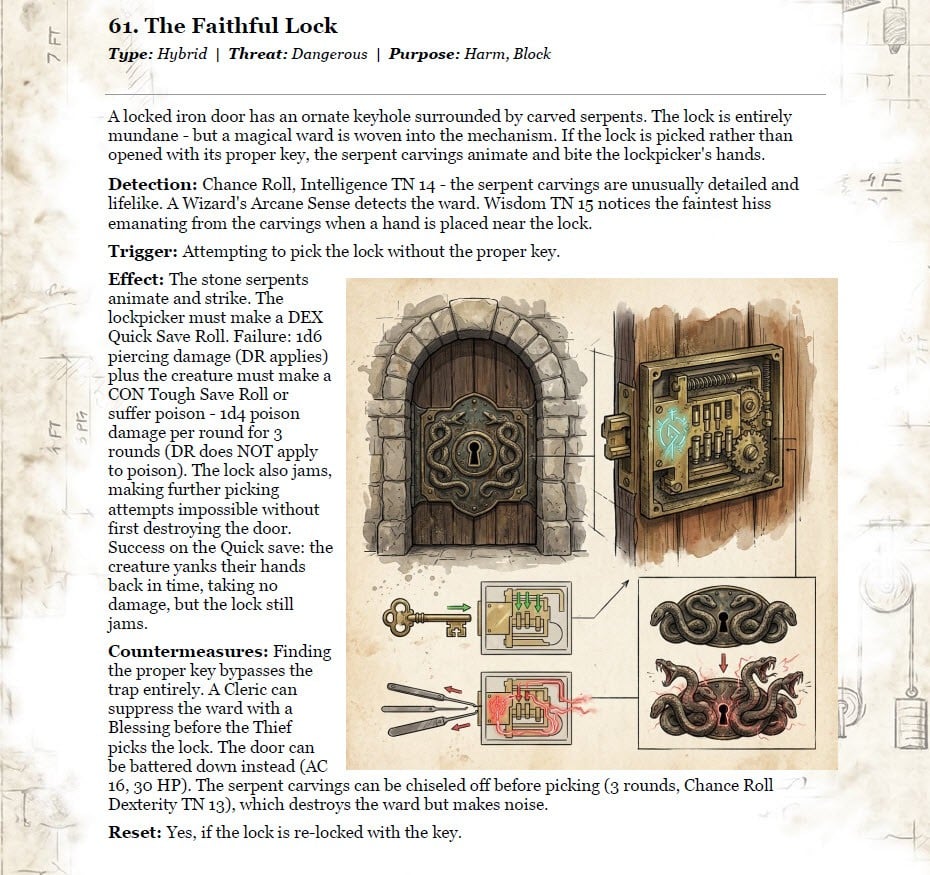
The hybrid category reaches perhaps its clearest expression in The Faithful Lock, where ordinary object interaction becomes dangerous through concealed enchantment. The door itself is iron-bound and fitted with an ornate keyhole surrounded by serpent carvings. At first inspection, the lock appears mundane, and that mundanity is part of the deception. The danger is woven into the mechanism rather than visible upon the surface. If a thief attempts to pick the lock without the proper key, the serpent carvings animate and strike the intruding hands, delivering piercing injury and poison while also jamming the lock afterward. The lock thereby changes state permanently unless further intervention occurs. The trapped object no longer remains a simple obstacle after activation; it becomes a worsening problem. The poisoned hands, the ruined mechanism, and the continued need to pass the door force immediate reconsideration of approach. The text also allows alternative solutions: the carvings may be removed, the ward suppressed, the key found, or the door physically battered down. This is precisely why the trap works so well. It punishes routine without eliminating agency.
The broader achievement of the volume is that almost every trap implies a history of use. Reset instructions are especially important here. Many modern trap collections ignore what happens after activation, but this book consistently asks whether a trap resets, how long that requires, and what labor would be necessary. This simple addition quietly strengthens worldbuilding. A resetting chain trap suggests maintainers or designed permanence. A sand chamber requiring reservoir refilling implies labor systems, servants, or mechanical maintenance. A magical lock that resets only with the proper key implies disciplined access rather than accidental enchantment. Such details matter because they make traps feel built by societies rather than invented solely for players.
The illustrations contribute significantly to this effect. They do not merely decorate the page but clarify engineering. In the case of The Strangler, the comparison between armed and triggered states makes pulley logic immediately understandable. In The Faithful Lock, the visual cutaway of the lock mechanism explains why the magical retaliation feels integrated rather than abstract. In The Sandglass Room, the chamber's vertical arrangement becomes legible in a way that supports quick narration. Visual clarity of this sort reduces the burden on the Dungeon Narrator, particularly in live sessions where verbal explanation must remain concise.
What emerges from the collection as a whole is a return to an older understanding of dungeon play, one in which danger is not merely numerical but environmental. Traps are not interruptions. They are arguments made in stone, iron, dust, and pressure. They force the party to stop assuming that a corridor is neutral space. They make architecture suspect. They encourage listening, probing, measuring, and hesitation. In that sense, 92 Traps to Die For does not simply provide hazards; it restores caution as a central mode of play.
The most impressive quality of the work is that despite the number of entries, repetition rarely becomes mechanical. The traps differ not only in surface theme but in the kind of thinking they demand. Some test observation, others speed, others endurance, and others class coordination. A cleric may matter because a blessing suppresses a ward. A thief matters because a pulley can be disabled before activation. A fighter matters because brute force becomes the only answer when subtlety fails. This variety gives the volume practical longevity. A Dungeon Narrator can draw repeatedly from it without producing predictable sessions.
For campaigns built around ruins, tombs, vaults, fortress interiors, or forgotten underground structures, the book offers something increasingly rare: hazards that feel authored rather than arbitrary. It understands that the best trap is not the deadliest one, but the one players remember because the room itself changed the moment they entered it.