Monster can be found here: https://opendungeons.com/monsters/
In Open Dungeons™, alignment does not apply to player characters. You have full agency to decide how your character thinks and acts in the world. No chart, grid, or label can dictate your choices - your character's morality and personality are entirely yours to roleplay.
Alignments exist to describe how races, cultures, factions, and monsters are generally viewed. It is not an absolute law - individuals may differ - but it provides a shorthand for how most of the world understands a group's tendencies.
Some monsters, like animals, don't understand hierarchy - alignments isn't chaos or freedom - this is a creature locked into behavioral loops. Think of it like a very complex biological machine - it's not choosing to respect structure; structure is literally hardwired into its existence.
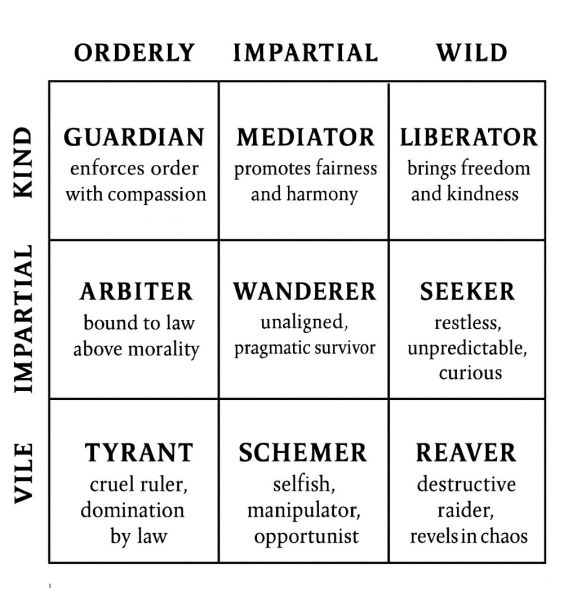
Top - Laws and Structure (X-Axis)
This is about how a creature relates to rules, order, and authority.
Orderly: Respects hierarchy, routines, or natural laws. These creatures thrive in systems and usually enforce rules.
Impartial: Indifferent to laws or rules. They follow them when convenient, ignore them when not.
Wild: Rejects laws and structure outright. These creatures value freedom, instinct, or chaos above imposed order.
Side - Treatment of Others (Y-Axis)
This is about how a creature values or disregards the well-being of others.
Kind: Respects life, acts with compassion or mercy, even toward enemies.
Impartial: Neutral toward others. Neither kind nor cruel; decisions are pragmatic or situational.
Vile: Disregards life, thrives on cruelty, selfishness, or malice. Others are tools, prey, or obstacles.
Treasure and rewards are always decided by the Dungeon Narrator. Please see DN Guide for further details.
Intelligence shapes how a monster fights, plans, and responds to danger - and it's one of the easiest stats for DNs to forget in the heat of combat. A Rime Howler (Int 1) doesn't understand the wizard is the real threat; it attacks whatever's closest or bleeding. But a Char Mauler (Int 12) recognizes spell components, focuses fire on the healer, and knows when a tactical retreat beats a glorious last stand. The difference turns a forgettable encounter into a memorable challenge.
Beyond combat, Intelligence determines whether creatures can be reasoned with, deceived, or outwitted. You can't negotiate with an Acid Slime (Int 0) or bluff a Carrion Hunter (Int 1) - they simply don't have the cognitive framework for it. But that same Ferric Reaver warband the party just ambushed? At Int 10, they understand surrender, can be interrogated, might even switch sides if the offer's good enough. High-Intelligence monsters (14+) become recurring villains because they learn from defeats, adapt their tactics, and remember grudges. They're not just obstacles - they're opponents.
DN Note: Intelligence affects how creatures fight, negotiate, and react to being outsmarted. A dragon with Int 16 doesn't just breathe fire - it studies the party's tactics, targets spellcasters first, and knows when to retreat. A human with Int 7 fights bravely but predictably.
1 Animal: Instinctive only; acts on hunger, fear, or basic behavior. No abstract thought.
2 - 4 Low / Bestial: Limited awareness; can follow simple commands, use tools crudely, or learn
patterns.
5 - 7 Below Average: Simple reasoning; understands tone and intent, can plan simple actions or
react to traps. Comparable to ogres or goblins.
8 - 10 Average: Human-like reasoning; can read, speak, and plan. Understands cause and effect.
11 - 12 Bright: Learns quickly; can analyze patterns, remember details, and anticipate danger.
13 - 14 High: Skilled thinker; understands strategy, cause chains, and problem solving. Capable of
planning ambushes or studying magic.
15 - 16 Exceptional: Highly intelligent or educated; can outthink most humans. Skilled tactician or
scholar.
17 Genius: Inventive, theoretical mind; can conceive new techniques or magical theories.
18 Super-Genius: Among the smartest beings alive; understands complex systems, advanced
magic, or technology instinctively.
This formula scales to any group size. Always use the party's actual total HP and actions.
To judge encounter difficulty, follow these steps to assess Easy, Challenging, Hard, or Deadly.
Step 1: HP Baseline
Add up monster encounter total HP.
Add up who party HP.
Monster HP ≈ ½ party HP = Easy
Monster HP ≈ equal party HP = Challenging
Monster HP ≈ 1.5× party HP = Hard
Monster HP ≈ 2×+ party HP = Deadly
Step 2: Action Check
Drop 1 step when Monsters has fewer actions than party's total.
Raise 1 step if Monsters has more actions (multiattacks) per round than party's total.
Step 3: Spice Bump
Raise 1 step if monsters have strong control, resistances, flight/range, or other tactical edge.
Drop 1 step if they're fragile, with no defenses or tricks.
Note: Encounter difficulty primarily measures combat duration and party exposure time. Remember that fragile classes (Wizards, Thieves) remain vulnerable to focused attacks and critical hits regardless of encounter rating.
Open Dungeons provides a digital tool: Monster Encounter Calculator
Tiny - sprites, rats, imps, moths, bats, toads, frogs, crows
Small - large spiders, beetles, small devils, giant rats, kobolds
Medium - hounds, ghouls, minor devils, humanoids, orcs, gargoyles
Large - drakes, trolls, ogres, dire wolves, minotaur, Chimera, horse
Huge - giants, phoenixes, stormborn dragons, cyclops, sphinx
Gargantuan - ancient dragons, elder wyrms, world-serpents, titan-scale giants
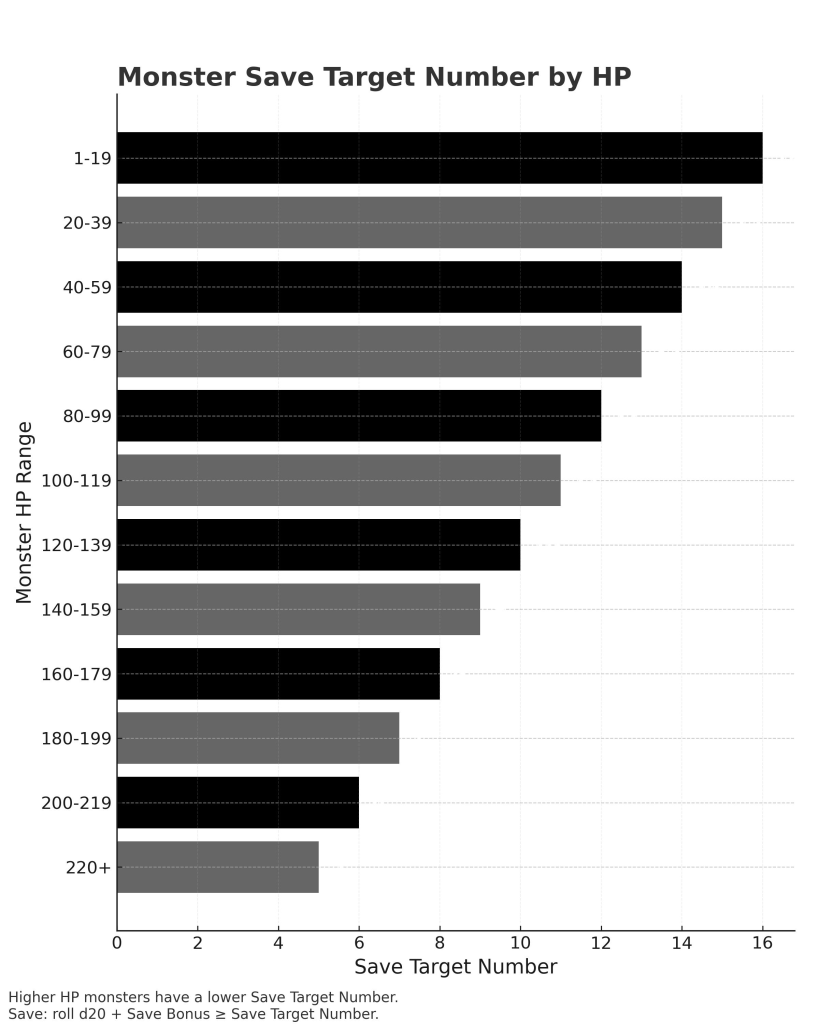
Monsters make Save Rolls when affected by spells, special abilities, or other effects that allow a save.
Base Target Number (TN) a monster has to Save Roll equal to or higher is 16, then subtract -1 from 16 for every 20 HP it has.
Any monster with 220+ HP has a base Save Roll TN of 5. However, the caster's level increases this TN by +1 per level, making it progressively harder for the monster to successfully save.
Save Target Number*
Monster Save Target Number = 16 - (Monster HP ÷ 20, rounded down), minimum 5 Note: Monster Save TN is based on max HP and doesn't change.
Examples:
Ghoul Gnawer (22 HP): 22/20 = 1 (rounded down), so 16 - 1 = Save TN 15 Spider Empress (400 HP): 400/20 = 20, so 16 - 20 = -4, but all monster save rolls TN never lower than 5.
Save Roll is just like characters making Save Rolls, just that monsters TN is based on Save Target Number.
Roll d20 + Save Bonus ≥ Save Target Number*
Example: a monster with TN 5 dodging an 8th level Wizard spell will need to roll 13 or greater on 1d20 because TN 5 + 8 = 13 new Target Number
Open Dungeons provides a calculator for you: Monster Save Roll Calculator
A cooldown is the recovery time before a monster can use a special ability again. The cooldown starts the round after the ability is used. So if an ability has a 2-round cooldown, the monster uses it on round 1, then it recovers during rounds 2 and 3, and can use it again on round 4. Think of it like recharging a battery - the ability needs time to power back up before it's ready to go again.
A monster stat block is a short record card. It shows you how a monster works in the game.
HP is Hit Points. Hit Points is how much damage the monster can take before it dies.
AC is Armor Class. This makes it harder or easier to hit the monster when you attack it.
DR is Damage Reduction. Armor and thick skin, hide, scale, etc. block some physical damage.
Saves Rolls can be ability bonuses from Quick (Dexterity), Tough (Constitution), and Mind (Intelligence).
These are the monster's defenses against special dangers. (see following page)
Alignment is its moral nature and what is its general disposition.
Intelligence of, is a rough idea of how clever or aware it is.
Magic Resistance has some creatures resist to spells or effects.
Number of Attacks is how many times it strikes in a round, on its turn.
Attacks Listing of damage. DN should see, read, imagine who they do attack with the aide of
Special Attack, Special Defense, its general stat block - interpreted through context including
alignment, size, description, etc.
Size is how large the monster is (e.g., Small, Medium, Huge).
Special Defenses - Things that make it tougher to harm or control.
Special Attacks - Unique actions it can take, often with effects like poison, fear, or breath weapons.
Resistant is 50% damage.
Immune is 0 damage - it's immune to damage or the affects.
Most damage is already understood: slashing, piercing, bludgeoning, fire, cold, lightning, bludgeoning,
or poison. Here a few more explained.
Acid is strong and corrosive. It eats armor, stone, and flesh.
Elemental is raw power drawn from the natural forces. It includes fire, cold, lightning, and acid.
These are the classic elements that scorch, freeze, shock, and corrode.
Force is raw magic energy. It knocks and smashes.
Necrotic is the energy of decay. It drains life.
Psychic is mind power. It hurts thoughts and spirit.
Radiant burns away darkness and undead.
Sonic is high-frequency vibration damage. It shatters glass, ruptures eardrums, vibrates objects.
Thunder is a loud boom. It is shockwave damage from sound.
Resist (resistant) = usually means only half or partial damage to particular attacks.
Immune = is no damage to particular attacks.
Poison (venom, monster) = -2 to all ability scores, -2 to all save rolls, and -2 too all attacks.
Weary = -2 penalty to all Save Rolls.
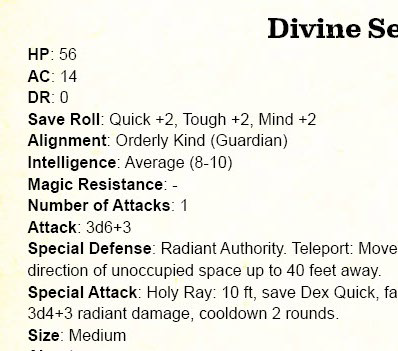
Players who memorize stat blocks from other systems expect predictable encounters. Open Dungeons breaks that pattern. The DN may read that the Divine Sentinel has "Radiant Authority" listed in its special defenses, or some other ability the stat block might not spell out exactly what that means
The DN decides what it means: maybe it's a commanding presence that forces a Wis Mind save or the character flees in fear for 1d6 rounds. Maybe it's an aura that makes lying or deception impossible within 30 feet. Maybe it lets the sentinel issue a single command that must be obeyed unless resisted.
The same goes for abilities like that are mentioned but with not details i.e. Elemental Nature, Damage Immunity, etc. Let's take Teleport ability as an example. If the stat block ability doesn't mention "once per day, 60 feet, line of sight only..." the DN can interpret it based on context. In a tight dungeon corridor, maybe the sentinel blinks 30 feet to flank the party. In an open temple courtyard, maybe it vanishes and reappears 60 feet away on a balcony. The mechanics serve the story, not the other way around.
You may find these abilities in Special Defense or Special Attack and discover their details in their About sections.
Creative Freedom for the DN
This flexibility isn't vagueness - it's intentional design. The DN knows their table, their players, and the flow of the encounter better than any rulebook ever could. If "Radiant Authority" needs to be a devastating effect against a high-level party, it can be. If it needs to be a minor inconvenience for a low-level group, it can be that instead.
Stat Block = Function
About = Inspiration
DN Interpretation = The Final Word
When in doubt, ask yourself: What would make this encounter memorable? What fits the tone of this creature? What keeps the players on their toes? Then rule accordingly. The stats are guidelines, not shackles.