Open Dungeons™ intentionally leaves certain terms - Prone, Grappled, Concentration,
Reaction, Advantage, and similar - without fixed definitions. This is by design.
When these words appear in a monster stat block or magic item description, treat them as
narrative shorthand, not rules references. "Knock prone" means the target is on the ground.
What that costs them, how long it lasts, and what it takes to recover is your call. "Advantage on
checks" means the creature has a meaningful edge in that situation. Whether that's a reroll, a
flat bonus, or a narrative benefit, you decide.
Locking these into rigid definitions opens the door to metagaming. Players who memorize
condition tables start looking for loopholes. Players who trust their DN to make a fair call stay in
the story.
When one of these terms comes up, ask yourself: what makes sense here? What fits the
creature, the moment, the encounter? That's your ruling. Write it down, stay consistent, and it
becomes part of your table's physics.
The books give you the vocabulary. You give it meaning.
The free animated dice roller that actually rolls circles around the competition
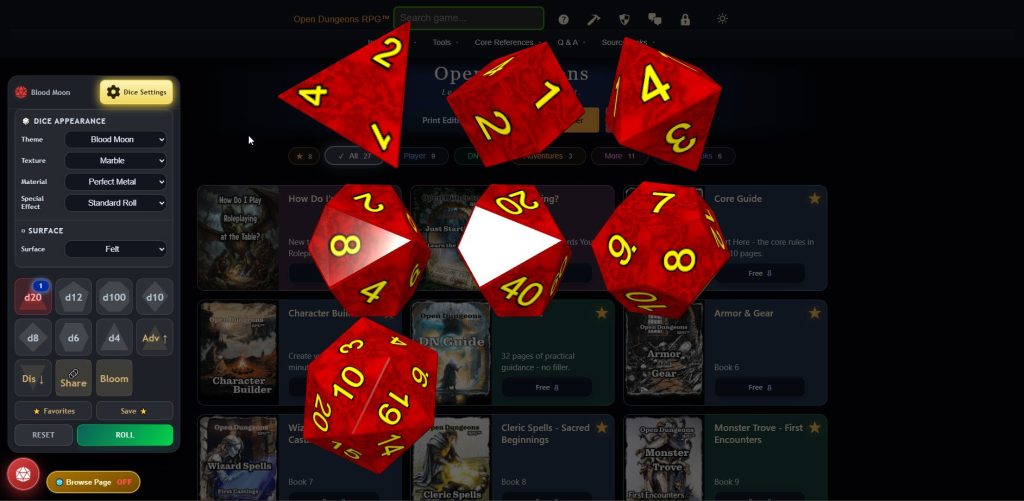
If you have been playing tabletop games long enough, you remember what it felt like the first time you saw a computer roll dice on screen. It was astonishing. Here was a machine doing something that belonged on a felt table, and it was doing it in glowing phosphor, and that felt like the future arriving right on time.
The future kept arriving. Digital dice got smoother, prettier, more capable. What nobody anticipated was the moment someone would look at all that progress and decide the logical next step was to sell you a skin pack.
Enter Open Dungeons Dice. Exit the tollbooth.
What You Are Actually Getting
Open Dungeons Dice is a free, browser-based animated dice roller built directly into the Open Dungeons site, and it is not fooling around. Three-dimensional rolling. Real sound effects - the kind that make other people at the table look up. Bloom lighting. Twelve-plus special effects. A full customization system built around themes, textures, materials, and surfaces that you combine yourself to create over 200,000 distinct dice sets.
Not 200,000 things to purchase. Not 200,000 things to unlock through a battle pass. Two hundred thousand dice sets you build yourself, free, right now, from any browser on any device.
No account. No login. No subscription. You show up, you build your dice, you save your favorites, and if you want your whole table rolling the same custom set by Friday night, you paste them a link. That is the entire transaction.
What D&D Beyond Is Selling You Instead
D&D Beyond's digital dice live in a marketplace. Individual sets run around $5.99. The Blacksmith's Digital Dice Pack comes in at $7.92 for eight sets with animations and metallic sound effects. What you get for that money is one fixed look - a skin you bought off a shelf that rolls the same way every time, with no ability to change it, build on it, or share it with friends who did not also pay for it.
That is not a dice forge. That is a vending machine.
The product is also visibly shakier than it should be for something with a price tag on it. A March 2026 forum thread on D&D Beyond's own site ran under the title "Digital dice not rolling," with users reporting their paid dice simply would not function. A Beyond20 GitHub issue from around the same period noted that a D&D Beyond update had restructured the page HTML enough to break digital dice display for that integration entirely. Other community posts described players disabling digital dice altogether just to stop their character sheets from crashing.
Paid dice that crash your sheet. Free dice that do not. The math here is not complicated.
The Forge vs. The Vending Machine
Open Dungeons Dice is built on a completely different philosophy. Instead of selling you a fixed look, it hands you the tools to build your own. Themes, textures, materials, surfaces, bloom settings, and twelve-plus special effects all combine independently. That is how you get over 200,000 possible dice sets out of a free tool with no storefront attached. It is the difference between buying a painting and having a studio.
The sharing system is worth calling out specifically. Build a set you love, copy the URL, send it to your whole group. Everyone rolls the same custom dice without owning an account or spending a cent. Try doing that with a purchased D&D Beyond skin pack.
Mobile support is where most browser dice tools quietly embarrass themselves. Open Dungeons Dice was built from the start for small screens. Settings collapse cleanly, the roller stays readable, and the animation runs smooth whether you are on a phone wedged next to a pizza box or a laptop at a proper table with actual chairs. The experience does not degrade. It just works.
D&D Beyond sells dice sets one at a time from a marketplace, delivers a fixed product with documented reliability problems, and gives you no way to share or customize what you bought.
Open Dungeons Dice gives you over 200,000 custom animated sets, bloom effects, twelve-plus special effects, full 3D animation, audio, mobile support, shareable links, and saved favorites, all free, all yours, no account required.
Your dice should not live in someone else's storefront. Build them. Save them. Share them. Roll them.
The Open Dungeons Animated Dice Roller is free at opendungeons.com - no account or subscription required.
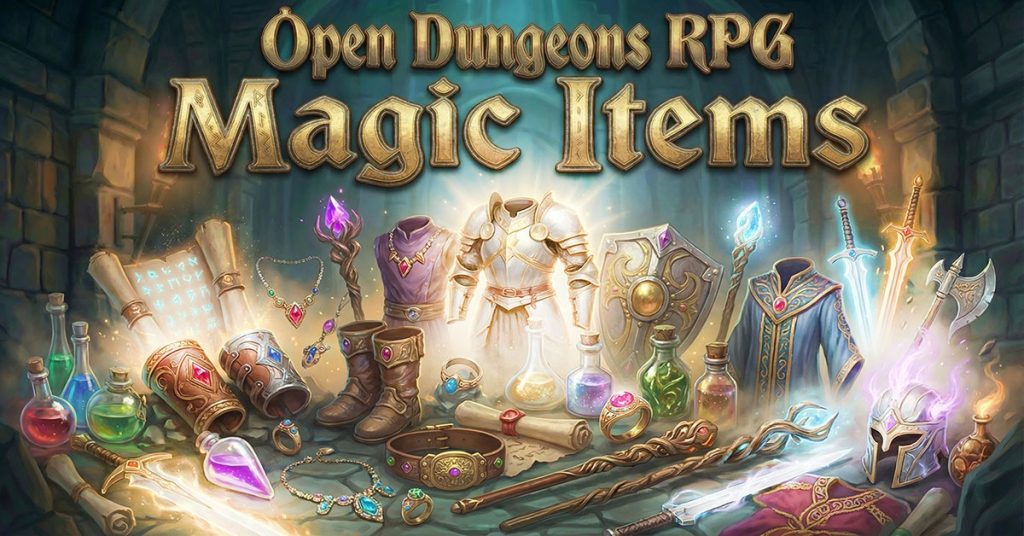
Find magic items here: https://opendungeons.com/magic-items/
Check rolls are Chance Rolls: you take action and see if it works, or attempt something to see if it works.
Example, STR checks, you are attempting to try and do something with physical strength like lifting a fallen beam off a trapped ally.
These are "Chance Rolls." See Core Guide page 5.
Crafting magic items is not a skill or proficiency. It is a rare process that requires the right materials, the right conditions, and a reason.
Characters do not learn to craft magic items through training. Instead, the DN decides when creation is possible - usually involving rare ingredients, powerful magic, or an extraordinary source of energy.
Some items call for divine guidance, ancient formulas, or relic fragments. If characters pursue crafting, the DN decides what is required and what the result becomes - often serving as part of the adventure itself.
Some magic items come with a set number of charges. The number may be fixed or determined by a dice roll listed in the item's description. These are not daily uses unless the item states so. Charges do not regenerate on their own. Once an item's final charge is used, its magic is spent and the item becomes non-magical.
In rare cases, an item may retain a faint magical resonance. The DN may allow it to be recharged under special circumstances - the right ritual, a costly payment, or by seeking an individual or creature capable of re-infusing the item with new energy. Such methods are never assumed and always require DN discretion.
Magic items might be identified if DN states such behavior exists when near it, holding it, wielding, etc. including cursed items.
Magic items do not automatically reveal their properties. A character understands an item's exact function only after examining, testing, or attempting to use it under the DN's guidance. A short period of handling - a few moments or minutes - is usually enough for basic items such as simple weapons, armor, potions, or charms.
More complex items, items with multiple effects, or items tied to a specific tradition may require a longer inspection or relevant lore.
Cursed items can conceal their true nature and may appear entirely normal until used. The DN decides how much information an item reveals during examination and whether additional time, knowledge, or experimentation is needed.
Magic does not make an item indestructible. If fire burns leather or acid eats steel, a magic version of that item can also be burned or eaten. A magic sword can still chip. A magic cloak can still tear. Protect your gear.
Unlike ordinary equipment, magic items retain their enchantments indefinitely unless specifically dispelled, destroyed, or used up. Magic, however, does not make an item indestructible.
A potion is still a liquid in a simple glass vial that can crack or shatter. A scroll is still parchment that can tear or burn to ash. Magical armor can be eaten away by acid just as easily as mundane steel. Enchanted blades can chip or snap if struck with enough force.
If a magic item's physical form is broken, burned, corroded, or otherwise ruined, its enchantment is lost along with it. The only exceptions are true artifacts or other legendary relics, whose durability is tied directly to their immense power.
Any item may be cursed which can be determined by the DN and its effects that can be opposite of its magic description and bonus. DN could add flare and other details.
Cursed items usually hide their true nature until used or worn, and the DN decides when and how a curse reveals itself. A character can only be affected by one curse at a time. If another curse is applied, the stronger curse takes over and the weaker one ends or becomes dormant, as the DN decides.
Curses can be removed through many means: specific spells, rare potions, powerful blessings, magical items, rituals, or enough time under the right conditions. The DN determines which method applies based on the story, the strength of the curse, and the needs of the adventure.
This effect, Magical Backlash, does not apply to magical items being cast. Magic Backlash only applies to casters casting magic themselves.